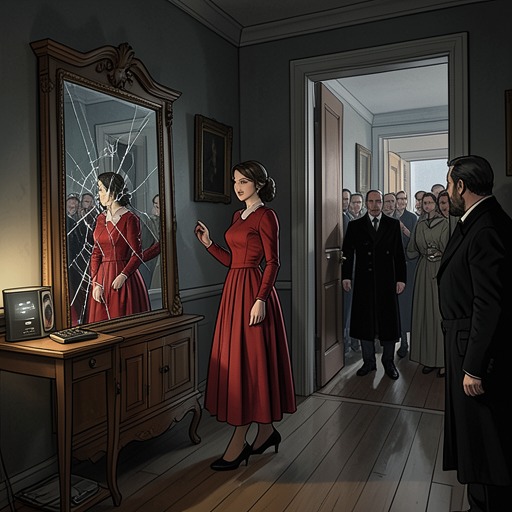
Carrie Dresses for the Spring Ball
Stephen King Three Classic Novels Box Set: Carrie, 'Salem's Lot, the ShiningCarrie Dresses for the Spring Ball marks Carrie White’s first sustained attempt to inhabit a public identity of her own. On the morning of May 27, she puts on the nearly floor-length red dress in her room, experiences both shame and defiant excitement, and then resists Margaret White’s demand that the garment be removed. The encounter turns a dress into a boundary: Margaret treats Carrie’s body as sinful property to be controlled, while Carrie claims the right to name and present herself. The confrontation ends with Carrie using telekinesis to force the door shut and quietly accepting that her relationship with her mother has changed.
The Dress and the New Body
Carrie puts on the dress for the first time in her room, wearing a special brassiere that gives her breasts the intended uplift while leaving their upper halves uncovered. The dress is almost floor length, with a loose skirt and a snug waist; its rich, unfamiliar material contrasts with the cotton and wool she normally wears. The physical sensation produces a divided response. She feels shame because the garment exposes a body she has been taught to conceal, but she also feels excitement because it gives that body a new public shape. Clothing therefore becomes more than decoration: it is the first material form of Carrie’s movement toward an identity not wholly dictated by Margaret.
The color intensifies that conflict. When Margaret sees the dress, she immediately identifies it as red and treats the color as evidence of corruption rather than as a feature of formal clothing. Carrie initially says nothing, but her back straightens in a patch of early spring sunshine. That involuntary change in posture is crucial: before she argues, her body registers a new steadiness. The scene presents her physical bearing as the first visible sign that the old arrangement between mother and daughter is weakening.
Margaret White’s Religious Rejection
Margaret objects not only to the dress but to the body it reveals. She describes Carrie’s breasts through the religiously charged phrase “dirty pillows” and insists that other people will look at Carrie’s body. Carrie answers, “Those are my breasts, Momma. Every woman has them.” The reply is unusually direct. It rejects Margaret’s attempt to transform an ordinary female body into proof of sin and places Carrie within a wider category of womanhood that Margaret’s doctrine has denied her.
Margaret orders Carrie to take off the dress and proposes burning it in the incinerator, staying home from work, keeping Carrie home from school, praying, doing penance, and asking for a religious sign. Her response makes the domestic room resemble a site of judgment and ritual purification. The red dress is treated as something that must be destroyed so that Carrie can be returned to obedience. Margaret’s fundamentalism turns an ordinary preparation for the Spring Ball into a test of faith, with Carrie’s independence cast as a demonic contamination.
Margaret’s zeal becomes physically self-destructive. She pinches her own face until it leaves a red mark, tears her claws across her cheek so that thin blood appears, and strikes herself in the mouth. She touches the blood and marks the cover of the Bible, invoking purification through sacrifice. The gestures make blood simultaneously a sign of sin, punishment, and religious possession. They also invert the earlier shower-room trauma, in which Carrie’s menstrual blood exposed her to public humiliation: here Margaret produces blood deliberately, attempting to make her own suffering control Carrie’s decision.
Carrie’s Refusal and Telekinetic Boundary
Carrie does not yield. She tells Margaret to stop hurting herself and states that the self-punishment will not make her remove the dress. Her refusal is not delivered as a long declaration; its force lies in its calm persistence against Margaret’s escalating performance. When the door suddenly slams open by itself, the room’s conflict becomes physically manifest. Carrie’s psychic ability is no longer merely a hidden potential associated with moments of extreme personal stress. It becomes an instrument through which she can alter the domestic space.
Margaret invokes biblical punishment, comparing Carrie’s fate to Jezebel’s fall from a tower. Carrie leaves the room, but Margaret’s resistance continues. Carrie’s feet slip across the floor as though the wood had become ice; she catches the doorjamb, and her fingers are torn loose by an apparently invisible force. Even while being expelled from the room, she speaks with controlled tenderness: “I love you, Momma,” followed by an apology. The words preserve attachment without restoring submission. Carrie’s love and her refusal coexist, making the separation more painful and more decisive than a simple rejection of Margaret.
At the threshold, Carrie envisions the door swinging shut, and it does so. She carefully disengages the mental hands with which she has pushed her mother, then holds the door closed while Margaret pounds against it and raves about judgment. Carrie’s telekinesis here is precise rather than indiscriminate: she uses it to establish distance and explicitly tries not to hurt Margaret. The closed door becomes a physical boundary between maternal authority and Carrie’s emerging autonomy. After Margaret goes away, Carrie watches her descend the walk and cross the street toward work, then presses her forehead against the glass and addresses her softly. The scene thus ends not in emotional freedom but in a painful, unfinished separation.
The Spring Ball as Public Reversal
The private dispute over the dress prepares the reversal that occurs at the Spring Ball. Earlier, Carrie’s body had been exposed through menstruation and subjected to communal ridicule; at the dance, the same girl appears in formal clothing and is placed at the center of a public ceremony. The school’s senior-class president, Victor Mooney, calls students to their seats for the voting, and the event converts social judgment into an official pageant of rank.
The result briefly reverses Carrie’s position. Tommy Ross and Carrie win the election by one vote, and Victor announces them as King and Queen of the 1979 Spring Ball. Carrie is startled and nearly overwhelmed by the applause, while Tommy takes her hand and grins at her. The red dress, initially condemned by Margaret as a sign of shame, has become part of Carrie’s ceremonial appearance. Yet the reversal is unstable. The applause contains satiric overtones, and the public celebration remains embedded in the same school culture that had allowed Carrie to be humiliated. Her elevation is therefore both genuine recognition and a precarious performance staged before an audience capable of turning ceremony into cruelty.
Foreshadowing and Narrative Significance
The scene’s domestic violence foreshadows the later Spring Ball disaster through its repeated imagery of red, blood, exposure, and religious judgment. Margaret’s bloodied mouth, the mark placed on the Bible, the command to burn the dress, and the invocation of Jezebel all anticipate the collision between Carrie’s public appearance and the punitive spectacle arranged around her. The earlier shower-room event has already established that blood can make Carrie the object of collective laughter; the dress scene shows her attempting to reclaim control over how her body is seen.
The action also reveals the limits of Carrie’s first rebellion. She can straighten her back, answer Margaret directly, leave the room, and close the door through telekinesis, but she still says that she loves her mother and watches her leave with sorrow. The refusal is consequently neither a clean emancipation nor a victory over religious domination. It is a threshold moment in which Carrie discovers that resistance is possible, while the emotional bond that makes resistance costly remains intact. By linking the red dress to bodily self-recognition, maternal coercion, psychic power, and the later coronation at the Spring Ball, the episode makes Carrie’s clothing a material emblem of an identity that Margaret can condemn but can no longer completely govern.